It's now two and a half years since my major surgery and my next
scan is imminent. I have a CT scan every six
months for the first three years and then every year until five years
have elapsed - at which point the NHS considers you to be cured.
Up to now, all of the scans have shown me to be clear of the
disease. So chronologically, I'm nearly halfway there. But in terms
of the level of risk I'm over the worst.
Two and a half years ago I found out I had a high risk of
recurrence of the disease. After the tumour is removed from your body
they do a laboratory analysis of it and make a prognosis. I was then
told I had a 30% chance of dying.
Obviously this is very tough knowledge to assimilate. Learning to
live with such a huge threat is an enormous problem. There is big
dark cloud across your sky every day. And the long nights are the
worst. At that time I was still in a lot of pain from my major
surgery. My world seemed to revolve around the hospital and GP's - I
was still very much a patient.
After a year or so I began to find some light inbetween the
darkness. I learned to live more in the here and now. With my prognosis that
seemed the only real place to be. But I was still being assessed for
follow-up surgery and whenever a scan became due the darkness would roll in and cover my
sky again (particularly when I was waiting for the results).
Over the past year there has been much more light than dark. I'm
not going to have follow-up surgery and I've stopped seeing myself as
a patient. I've become able to do all the things I used to do before
I was ill, including cycling and hillwalking. I've also embarked on a
new relationship, which is going very well. In short, I'm feeling
fully recovered.
Recently I had a meeting with a urology consultant who told me
that recurrences of the disease would normally be seen within the
first two years. After that the level of risk decreases steeply
towards five years, at which point I would have a 2% risk of dying
from the disease.
On the face of it, this is reassuring. But if you happen to be one
of the unfortunates in whom the disease recurs, statistics don't
really matter.
So I'm waiting for the letter from the hospital to come through
the door and tell me the date of the scan. It should arrive soon. I
can feel my anxiety rising. As I've become more fully alive, it feels
like I've much more to lose.
Tuesday, 28 January 2014
Saturday, 18 January 2014
The Memorial Walk
Yesterday I walked up the North Ridge of Slieve Commedagh to the memorial I'd made for Gill in 1999. The spot I'd chosen was at the northern end of the summit plateau; I had built a cairn from stones I'd found nearby.
Slieve Commedagh means the Hill of the Watchers. It's easy to imagine it as a good place for a lookout as you can see all of Newcastle and Dundrum Bay below as well as across the Mournes and far inland too.
I hadn't been there for 3 years (this was the first time since my illness): I repaired the cairn and laid a bouquet of flowers.
Gill died in an accident in Snowdonia in 1987. She was 27 years old and an experienced hillwalker. We were engaged to be married and had just bought a house together. She died three weeks after we moved in. Our house was still full of boxes. For a very long time I couldnt bear to go there. I stayed with good friends Phil and Jean instead.
Much has happened over the past 27 years but I have never forgotten all that Gill gave to me. In her short time on this earth she made a difference to many lives - mine in particular.
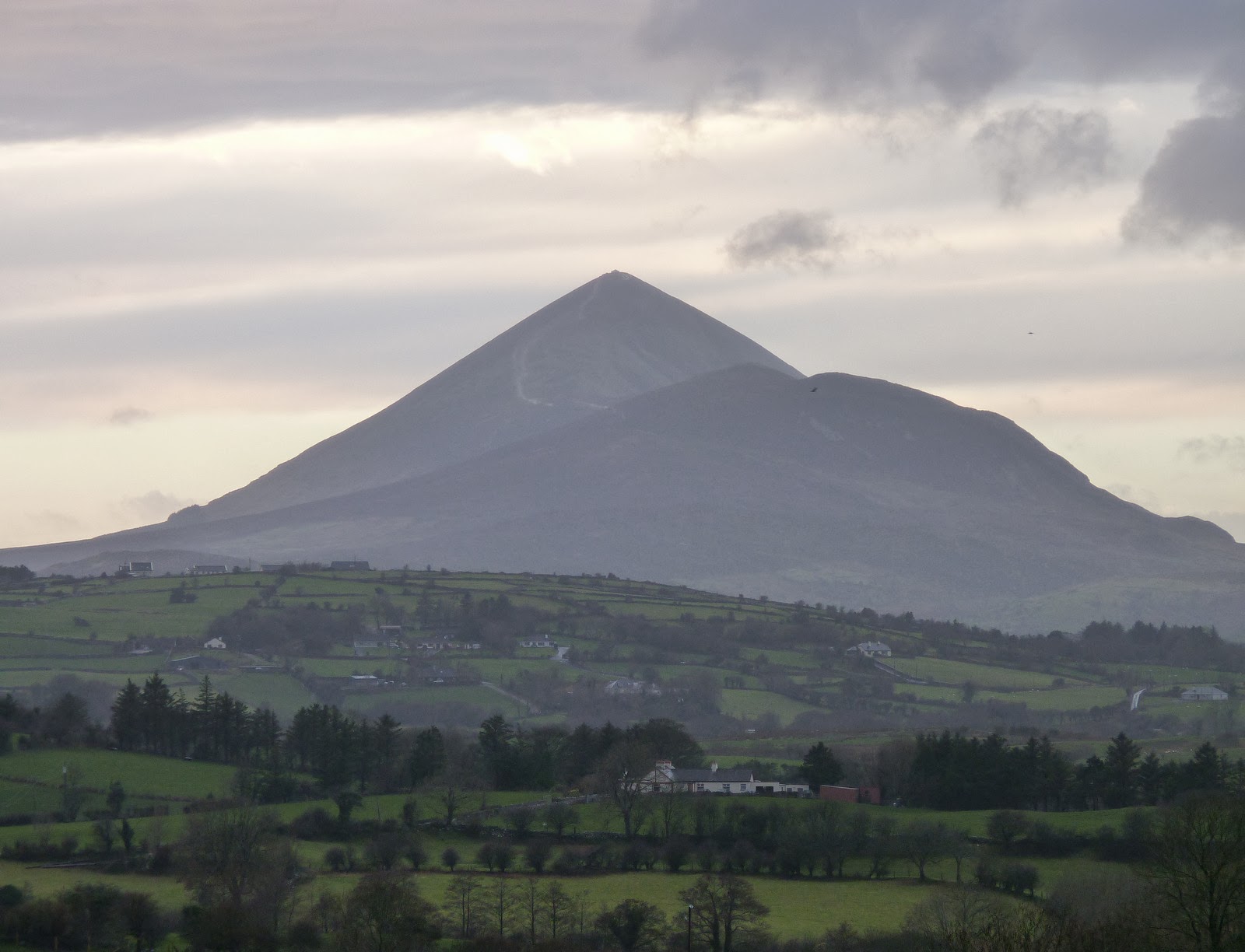
Slieve Commedagh from the West; the memorial is at top left.
Friday, 17 January 2014
Gill Banks
Gill died this day 27 years ago
At 27 years of age
In her too few years on this earth she gave so much
And since she has gone she's continued to give
Rest in Peace
With Love
Paul
Friday, 10 January 2014
The Wild West
Whether you enjoy mountains, moorland, cliffs, beaches, fresh air, fine cuisine or intriguing heritage, Mayo has it all. The wildest and most unspoilt of Ireland's western counties is a great destination.
T and I set out early in the New Year and drove to Enniskillen and Sligo. There we ascended to Queen Maeve's Cairn with its expansive views from Benbulben to the Ox Mountains and then headed on to Ballina. We paused at Downpatrick Head with its sea stacks and at Ceide Fields before traversing the great expanse of peat moorland that stretches all the way to Achill Island.
We arrived at the Mulranny Park Hotel and were given the bridal suite, complete with four poster bed and bay window overlooking Clew Bay to Croagh Patrick. After a sauna and a wonderful meal in the Nephin restaurant, we were definitely on honeymoon.
The hotel was built 100 years ago to accomodate tourists on the Westport to Achill line. The railway closed in the 1930's and was recently turned into a Greenway for walkers and cyclists. The first day we did a long moorland walk under the Nephin Beg Mountains before returning for our regulation sauna and grand evening meal.
After an enormous storm throughout the night, I went for a hillwalk whilst T explored the Greenway. The so-called pilgrims route up Croagh Patrick from Murrisk starts out steep, levels off briefly at 1500 feet, then gets steeper. The top of the mountain was plastered with fresh snow but many hardy pilgrims in trainers, hoodies and a trusty staves made it to the summit. Freed from sin, we trudged down with lighter loads.
Our last day was stormy, we drove through the brooding Dhulough Pass (Ireland's Glencoe) to Killary Harbour: which Churchill wanted to use for submarines during the Second World War and offered Northern Ireland in payment for, but De Valera refused the deal.
We drove back via Aghagower, the site of a monastery and bishopric from the 5th Century. What remains are ruins and the stub of a round tower, a few houses and a pub with a grocers. St Patrick would have set out from here on the last stage of his reputed pilgrimage to Croagh Patrick, some eight miles due West. The modern pilgrims route follows a quite different path. As do modern pilgrims.
Tuesday, 31 December 2013
The Old New Year
Looking back I see just how far I've come over the past year. In short, I've fully recovered from a life-threatening illness and now I'm thriving. Here's wishing you all, near and far, a Happy New Year.
A year ago I was still very much under the bleak cloud of the illness, very afraid I'd have to go back into hospital for more surgery. In January I was told this wouldnt be necessary and I walked forward with a spring in my step for the first time for a year and a half.
Sadly, Jean, a very close friend for 30 years, had the opposite news. Her cancer came back aggresively and she died in April. At that time I was also helping a group of cancer survivors from the Sing for Life Choir prepare for the Belfast Marathon Walk. All completed the 9 mile walk successfully and we raised £2500 for Cancer Focus. I continued singing with the choir (the earliest of my new activities) and have learned to sing better, or at least to make fewer mistakes.
During the Spring I began to write poetry again, for the first time since my illness. I challenged myself to write new poems around words chosen at random from the OED. This was stimulating and very productive. I also noticed that I seemed to be writing in a different style.
Indeed, this was true of many of the activities I picked up again. The illness had been a watershed and I wasnt (indeed couldnt be) the same afterwards. Like Humpty Dumpty I'd had a great fall, and painfully and painstakingly I'd been put back together. But the pieces didnt quite fit like they had before: some parts of me (and my life) were now more important and others had diminished in significance.
For the two year anniversary of my 'big op' I rented a motorbike and went on a tour of the northern half of this island. The weather was great and the touring was good, once I got used to the motorbike: my old skills, unused for 30 years, came back. But I couldnt help envying the cyclists I passed as I sweltered under the sun in my all black bike kit.
The longest day found me on holiday in Shetland, my first real trip away since my illness. A great place for wildlife and costal walks. The evening light was fantastic, indeed it hardly gets dark - its called the Simmer Dim.
On my return I decided to try cycling again. At first I was tentative and managed small trips along the towpath at Scarva, then I got bolder. Before long I was doing the whole trip, some 40 miles. It was great to feel the wind on my face and through my receding hair. During my illness and recovery I thought I'd never be able to cycle again.
In the Autumn I joined a birdwatching group and went on field trips around NI and to Donegal learning much from the very knowledgeable Ivor. With Ray Givans from the Writer's Group, I began another new venture - a poetry night with a difference called The Squat Pen.
Lately, I extended my regular walking through Tolleymore and Castlewellan Forest Parks to actual hillwalks in the Mournes. Like cycling, this was another old activity I feared I would not be able to do again. But over the Xmas holidays I've climbed four mountains and managed each well.
Finally and most importantly of all, I've begun a new relationship. I met T during the Summer and we quickly became close. Since then its got better and better. We are undoubtedly an item. We begin the New Year together with a trip to a hotel in the far West of Ireland.
Tuesday, 24 December 2013
Tying the Knot
Only relatively recently has the Church and the State become involved in marriage: the Council of Trent (1564) decreeing that a marriage was only valid if it was conducted by a priest, and the State registration of such marriages commencing in the 19th Century.
But people have lived on these islands for the best part of 30,000 years, forming couples and raising children. The folk tradition of marriage here is called handfasting. For thousands of years, a couple would come to a special ceremonial place where their hands would be joined through a portal and then bound together with rope. This is the origin of the expression 'tying the knot'.
At the handfasting ceremony the couple vowed to stay together for a year and a day. At the end of that year they had a choice: to renew their vows permanently, to renew their vows for another year or to part. Under the latter option, the responsibilities of each as regards any children and the property they had held in common would be specified.
The word handfasting derives from Old Norse and refers to the making of a contract by joining hands. It is believed that handfasting was used to formalise the exchange of all manner of goods and property.
Handfasting ceremonies took place at special sites with a portal through which the hands of the couple were joined and bound. Some of these sites had special standing stones with a natural hole, or a hole bored through - such as the Holestone (see below) near Doagh, Co Antrim. Many portals were made of wood, perhaps the trunk of an old tree, and thus have not survived to the present.
At Lughnasa there were special fairs where young men and women from different tribal groups would meet and could become handfasted. One of the main sites in Ireland for this was at Teltown in Co Meath.
Handfasting remained a legal basis for marriage in Scotland until 1939. To this day, couples who have been married in church also come to the Holestone for a handfasting ceremony.
Tuesday, 17 December 2013
Christmas Concert
The Sing for Life Choir Christmas Concert took place at Fisherwick Church, Belfast last night, compered by our patron Noel Thompson of the BBC. Over 300 people filled the church to hear an almost flawless performance of carols, traditional songs and classic ballads.
The choir began with Gaudete and Lean on Me by Bill Withers, followed by a mix of The First Noel and Pachabel's Canon and then John Rutter's arrangement of All Things Bright and Beautiful.
In the first interlude, The Elderflowers Dance Theatre Company performed to Ave Maria sung by the excellent Roisin Gallagher.
Taking the stage again, the choir sang I'll Tell Me Ma and a rousing version of Unchained Melody, made famous by the Righteous Brothers, followed by Howard Goodall's arrangement of Love Divine and Fields of Gold by Sting.
The second interlude saw solo performances from Keith Acheson (flute) of Gabriel's Oboe and Maria Redondo (violin) of Faure's Pavane, both accompanied by Megan Boyd on piano.
The final section saw the choir and Roisin Gallagher sing The Lamb by John Tavener, followed by John Rutter's arrangement of For the Beauty of the Earth and then Irish Blessing, the choir concluded with our signature tune Something Inside So Strong by Labi Siffre.
We were in very good voice throughout and gained our first standing ovation. Thanks in particular go to our conductor Keith Acheson and to our accompanist Megan Boyd, both of the Crescent Arts Centre.
It was a show with real heart by a community choir each of whom has been in some way affected by cancer. Well done to Cancer Focus NI and The Crescent Arts Centre who have supported the choir from the outset. A great night indeed.
Subscribe to:
Posts (Atom)