Monday, 12 June 2017

Double, Double, Toil and Trouble

It has been an eventful week, during which my mind has turned to the Scottish play. After a campaign of smears and mud-slinging by the right-wing press, I’m delighted the national electorate swung towards a message of hope. Discredited Theresa May is now said to be on ‘death row’ and there have been street protests in Britain about her new friends, the DUP. Locally, I’m sad that our hard-working constituency MP, Margaret Ritchie, has been beaten by an abstensionist. This effectively silences us on any issue, as our new MP will not turn up to do anything on our behalf at Westminster.

I have my hospital bag packed. But I’ve not had a call from Admissions. So I wait anxiously, try to stay well and don’t make plans. It’s not exactly ‘death row’ but each day I wonder if this will be the last time I am able to go for a bike ride, or mow the lawn, or go out for a meal, before I have the surgery and become incapacitated for a long while. I’m living normal life with a heightened intensity as there is an underlying sense of grief at the losses I will suffer for many months to come after going under the knife again. Allied to this is also the fear that something might go wrong and I could be incapacitated forever.

Being experienced at major surgery (having come through two episodes of it in the last 18 months) means that I also know how tough an ordeal it is. I know my body can recover but I have no illusions about the severity of the pain that has to be endured and the long, hard struggle of recovery.

Our dear ginger cat, Cyril, has been missing for several weeks now. We’ve looked everywhere for him, and have put posters up offering a reward. Next door were feeding him each day in the porch of our house whilst we were away in England for a long weekend. But he has been missing since then, whilst his nemesis the big grey feral cat has been very evident in the garden. We think Cyril was beaten up and chased away so that the big grey cat could take all the food. One day last week the big grey feral cat sat in our back yard all afternoon in heavy rain. He just shook his wet pointy-eared head and glowered at us, green eyes glinting. We have renamed him Grey Malkin after the witches’ cat in the Scottish play.

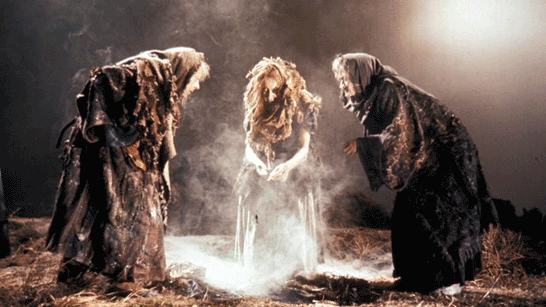
Perhaps I now need to boil a brew of toad, newt, snake, bat, frog, lizard and owl to help foretell my future. But even then I probably wouldn’t be much better off, as the witches’ spells for Macbeth were highly equivocal. The only way to reliably get to the future is to dig deep and live through whatever ordeal you are presently confronted with. This is as true for me as it is for the UK.


Sunday, 4 June 2017

Surgery Again

I am delighted with the all clear on my latest cancer surveillance scan. But there is a downside. It means I will shortly have to go into hospital for surgery: a thoracotomy to repair a diaphragmatic hernia. Last month I met the surgeon at the Royal Victoria Hospital. He explained the procedure and the risks and I signed the consent form. He told me that the surgery would be scheduled for this month, conditional on my scan being all clear. So now I am waiting for the phone call from the hospital. Frankly, I am dreading it.

This surgery is needed to repair a hole in my left diaphragm that was caused by the first big operation I had in 2011. I then needed open heart surgery to safely remove the tumour that had grown up my vena cava. My chest was opened up and the diaphragm cut as part of this procedure. At the conclusion of this long and complex operation, either the diaphragm was not sewn up properly or some of the stitches did not hold.

Some six months after the big operation I was offered surgery to repair the diaphragmatic hernia. I was still in a lot of pain from the big surgery, so I deferred it. Six months later I was again offered the surgery, I wasn’t mentally ready to go back in for another big operation so I deferred it again. At the next review, as I had learned to adapt to my limitations, the surgeon suggested that I continue to manage the problem conservatively (i.e. without surgery).

I did this for another year or so, but then I developed asthma. The specialist reckoned this was due to my left lung being under stress because my stomach was wedged in the diaphragm. I was living with restricted breathing, particularly after eating. He recommended that I again consider surgery to repair the hernia. I met the surgeon two years ago and was discussing having elective surgery when I got the first of my cancer recurrences, followed by the first of my post-operative lung collapses.

So to cut a long story short, here I am nine months after the surgery to remove the second cancer recurrence and I am now preparing to go back in to have more surgery. It aims to restore my normal anatomy and should prevent further lung collapses. Fingers crossed that this will be the end of it.

Because of the two recent operations I was forced to have, I am now much more experienced and know that I can recover from the ordeal of major surgery. But I realise that this operation is bigger than the two previous ones. And when the surgeon tells you that you will be ‘sore’ for three months afterwards (they normally minimise these cautions), it means you will be in a lot of pain for some considerable time: at least six months and probably longer.

A thoracotomy means that your ribs are split open to gain access to your lung and diaphragm. The muscles between the ribs are cut and they take a long time to repair. Nerves run along the edges of the ribs too and are easily damaged (one of the risks). Anyone who has had bruised ribs will know how painful it is just breathing, let alone coughing and sneezing.

The other issue is that the exact nature of the hernia and the extent of the repair will only be known after I am opened up. So how likely the procedure is to be successful is also unknown in advance.

My stomach has become fused to my diaphragm, so they have to be surgically separated. This means the very delicate cutting away of the tissues of the diaphragm from the stomach, being careful not to injure it (one of the main risks). Then the hole in the diaphragm is repaired with a polypropylene mesh patch that is stitched in place.

I am told I will be in hospital for up to two weeks and incapacitated at home for three months or more. I will also have to be very careful for a good while and not undertake any activity which could pull the stitches in my hernia repair.

I have met the surgeon three times and have asked lots of questions. But when I signed the consent form my heart sank. The rational part of my mind realises that it is sensible to have this surgery, but the rest of me is in a state of fear. I've had enough of hospitals and surgery. I am dreading the call. It could come any day now.


Saturday, 27 May 2017

Two Awards

I’ve just had the results of my cancer surveillance CT scan. Thankfully I continue to be all clear. After the long anxious wait, it feels like an award. It’s a bigger prize than the one I was shortlisted for in England. I’m relieved and delighted. My Oncologist says she is pleased with my progress. She still thinks I’m at medium to high risk of a further recurrence. But she will relax the surveillance regime a little. For the next year I will be scanned every four months (rather than every three).

Going away on a short break was a good strategy for coping with the enormous anxiety of waiting for the scan results. We stayed with my oldest friend Phil, who lives in the New Forest. We first met aged eleven. He lost his wife, Jean, to cancer four years ago.

Phil is a volunteer ranger in the National Park. He took us to some woodland near Lyndhurst which is being looked after by a local woodland management and charcoal-making charity. They take people on guided days out in the forest, show them how they manage the woodland, help them to make garden chairs from coppiced hazel and have a modern charcoal oven. Their guided days out are very popular and they will shortly be featured in a Channel Five documentary.

We walked through dense woodland, ungrazed by deer and ponies (kept out by high fences), and came across some ditches that dated from Saxon times. Wandering amongst the heavy green foliage felt like we had gone back in time to when the country was largely covered by broadleaved trees. It was a great distraction from the worry of waiting.

Phil drove us to the awards ceremony in Berkshire. The prizes for the Stanley Spencer Poetry Competition were presented by Lord Young in the little art gallery in Cookham. My heart raced as the names were read out. Alas, I was not called. My award was to be selected for the shortlist of this major prize.

At the reception afterwards I met the grandson of Stanley Spencer who is compiling his letters for publication in three volumes. Stanley had a very colourful personal life. He became infatuated with his life model and left his wife and children for her. After the divorce, he married the life model only to discover she was a lesbian and just interested in his money. He then sought reconciliation with his first wife and wrote very long letters to her, one of which was over 20,000 words. Understandably, his first wife remained unmoved. Stanley remained unhappily married to the life model, the marriage was never consummated and he kept writing to his first wife, even after her death.

On the way back we visited the Sandham Memorial Chapel near Newbury. It is a wonderful place, entirely covered with murals from Spencer’s experience as a medical orderly in the First World War. The chapel is filled with panels each detailing the everyday life of the soldiers: their work, encampments, relaxation, hospital treatment, death and resurrection. The place has an early Renaissance feel, indeed the chapel is based on one painted by Giotto in Padua. The central mural is the Resurrection of the Soldiers, where men and animals climb from their graves or from where they had fallen, carrying crosses. As a medical orderly, Spencer saw a lot of carnage and had to do all the worst jobs. He said he had buried so many dead bodies that he felt sure there must be something beyond death.

The murals are an immensely powerful work, most people in the chapel gaze at them without speaking. They capture the detail of everyday life and reveal the extraordinary that is within it. This forms the great theme of Spencer’s work, which he realises with such passion and intensity. Indeed, isn’t this exactly what poetry is seeking to achieve?


Tuesday, 16 May 2017

Scans and Writing

I’ve just had another cancer surveillance CT scan and I’m again waiting for the results. It’s now eight months since my surgery to remove the tumour and this is my third scan since then. The two standard resolution CT scans I had earlier were thankfully clear. I can’t have high-resolution scans because I am allergic to the fluid they inject you with to enhance the images. And even though I’m prepared to take the risk of the injection to get enhanced images, the radiologists won’t allow it. So if there is a regrowth of the tumour, I reckon that it should be big enough by now to show up on my standard resolution scan. And if not, I can then breathe a large sigh of relief.

But before any of that, there are the two long weeks of waiting until I see the oncologist and get the results of the scan. I’ve been in this situation before, of course, and it doesn’t seem to get any easier. I’ve just become more practiced at the coping strategies. One day at a time and do your best to keep busy. This works some of the time but certainly not for all of it, especially the wee small hours, when your fears stalk you remorselessly.  

This time around I am trying a new strategy: going away on a short trip. All the other times I have stayed at home, often pacing distractedly like an animal in its cage. We will be heading away to England to visit family and friends. I am also going to attend the awards evening of a major poetry competition that I have been shortlisted for.

When I got cancer in 2011, I stopped writing poetry. The poor prognosis I was given embroiled me in the biggest struggle for survival that I had ever experienced. Confronted by that, I could hardly function let alone write.

My first piece of writing was a memoir, which I embarked on for obvious reasons (it remains unfinished). And then I began this blog. Finally, after a couple of years, as I was still alive (to the surprise of one of my specialists), I tried writing poetry again. I didn’t write about my illness, that was too stark and raw, I set myself challenges to write poems around random words from the dictionary. I produced plenty of poems, but few of them were much good.

In 2014 I went on holiday to Orkney and found a fascinating place with layer upon layer of history – visiting the oldest house in Europe (from 5,500 years ago) on a windswept remote island and a series of magnificent Neolithic monuments built before Stonehenge. From this experience began to emerge a series of new poems, situated in time and place. In the end I wrote a sequence of ten Orkney poems.

After this I wrote poems in a different style. All were situated in place and time. Often they were stimulated by stories I had read in newspapers. They weren’t ‘found’ poems. The news story provided the jumping off point for the poem. Ciaran Carson called them ‘discovered poems’.

I began submitting my new poetry to competitions a couple of years ago. And I’m delighted to have had some success. I’ve won seven awards in poetry competitions and been shortlisted for at least another seven without gaining an award. I’ve only been sending my new work out to journals recently, but have already had poems published in The Honest Ulsterman and The Interpreter’s House. I think this confirms that I am pursuing a fruitful new direction in my writing.

My fingers are crossed for the upcoming Stanley Spencer Poetry Award. Indeed, it’s the biggest prize (£3500) that I’ve been shortlisted for. Reaching the final twelve in this competition is an honour in itself. Wish me luck.


Friday, 5 May 2017

A Dose of Books

I’m normally pretty healthy. I know that’s an odd thing to say, as I’m a cancer patient and I’m regularly in acute hospitals for treatment, scans and reviews with specialists. But apart from the Big C, which as far as I know I don’t have at present, I get ill infrequently and I lead an active life. So this past ten days has come as a bit of a shock, for I’ve been laid low with a bad dose of the ‘flu.

It began with a very sore throat, which quickly spread to my sinuses and chest. I went to bed surrounded by all the paraphernalia of a dose: boxes of tissues, bottles of Covonia expectorant and packets of Lem-Sip Max. I lay there for a whole week, blowing a nose which seemed to offer a never-ending font of mucous and coughing up a seemingly bottomless supply of green-yellow phlegm. I quickly became a Lem-Sip and Covonia addict.

The noble T ministered to me unstintingly. Meals were brought on a tray, binfuls of used tissues were dumped and regular trips to the chemist for fresh supplies of my drugs of choice were undertaken. When I wasn’t dozing, I lay propped on a pile of pillows. My only diversions were watching Cyril stretch, lick himself and go back to sleep at the end of the bed. Occasionally he would groan and twitch his way through a cat dream. I then moved on to Laurel and Hardy videos on Youtube.

After a few days I could concentrate enough to be able to read. I had a pile of books waiting. I began with ‘God’s Own Country’, a novel by Ross Raisin. It’s set in the North York Moors, an area I knew, and the narrator is a strange young man who lives on a farm, talks to himself and the creatures around him but has problems with other people. It is a compelling voice. The novel charts a peculiar relationship that develops between him and a young woman.

The next day I read ‘The Outrun’, a memoir by Amy Liptrot. It’s set in the Orkneys, another place I knew, where she grew up and where she returned, after a hedonistic decade in London where she became an alcoholic. The book describes her odd family and her recovery by spending time alone as a wildlife observer on one of the remotest Orkney islands (which I had also visited). It’s a brave journey of recovery through immersion in wildlife and the natural world.

Then I began ‘The Narrow Road to the Deep North’ by Richard Flanagan. This is a powerful multilayered novel of love and loss that brings together a passionate affair between a young man and woman, with the man’s later terrible experience as a POW forced to work on the building of the Burma railway by the Japanese. The book spans the entire life of the central character and gives voice to many of the other significant characters, weaving their extraordinary stories together very affectingly. I found it un-put-downable. It won the Man Booker Prize in 2014.

Finally I read ‘Beatlebone’ by Kevin Barry. It’s a whimsical novel that imagines a trip that John Lennon made to Mayo in 1978 to visit a deserted island in Clew Bay that he had bought anonymously. John encounters some very odd people including an incompetent local fixer and a group of Primal Screamers and he has some strange adventures. The book has some very witty and entertaining chapters but I felt it began to lose its way a little two thirds through.

After the week in bed I tried a couple of hours up, despite the sinuses and chest still troubling me. I switched from reading to watching TV in my dressing-gown and, despite not doing much, I felt tired. The next day I stepped outside for a short time. The weather was lovely, but I felt the keen wind. The day after, I began to feel that the bug was starting to dissipate a little. I sat at the computer and tried to write, ending up with this blog. I hope tomorrow will again be better. I’m still taking it easy, I know that real ‘flu often takes several weeks to clear.


Thursday, 20 April 2017

The Wanderer

Cyril has returned. We encountered him down the lane, not far from where I first found him. He cried out and came running over to us when we called him. We were delighted. In the back of our minds was the fear that he had been injured in a fight with the local feral cats or even worse. We walked together back towards the house, Cyril trotting along the lane in fits and starts. When we got near to the house he seemed to suddenly recognise where he was and ran ahead. He was waiting by the front door when we arrived.

As usual he tucked in to several bowlfuls of milk and food. He looked like he had been sleeping rough, his fur was a bit muddy and his ears were flecked with specks of dried blood. He licked himself all over and then went to sleep on the bed for some hours. Later on he got up and fed again, returning to bed after. That evening he went out into the darkness. As we closed the front door, we wondered if we would ever see him again.

But the next morning Cyril was back for a hearty breakfast. On the front doorstep was a piece of grey rabbit fur with a slice of flesh attached to the inside skin: a cat gift to reaffirm the bond. Afterwards I went to the local Post Office to remove the missing cat poster.

‘Did the cat come back on its own?’ said the postmistress.

I explained and thanked her.

‘Is it a boy?’ she said.

I nodded.

‘They do wander,’ she said, shaking her head.

Cyril had been away for the best part of two weeks. We had looked everywhere for him, especially down the lane where I first found him. Near the disused railway line was an old barn with bales of straw in it. I had pushed apart the brambles to reveal a cat sized hole in the straw in the corner.  We called and called but there was no Cyril to be found anywhere.

We had given up hope of seeing him again and had feared the worst. But wee Cyril has proved himself to be self-sufficient, in spite of our townland being full of wild creatures: feral cats, badgers and foxes.

His little purring presence and big personality have made a real difference to our house. He’s been with us all this week. We hope Cyril stays for a good long while before his next wander.


Monday, 10 April 2017

Cats and the Bonfire

We enjoyed having Cyril with us. He was easy to get along with. He would be out all night, returning early in the morning with a gift of a dead mouse or shrew. After his large breakfast he would sleep. Towards evening he would liven up and play with us and his toys. He enjoyed accompanying us on our after-dinner walks, trotting along like a little ginger dog. After a hearty supper he would go out for the night. Cyril was good company. Unfortunately, one day last week he disappeared. We have looked everywhere for him. We even put a notice in the local Post Office, offering a reward if he was found. But there is still an empty space where he used to sleep.

Despite Cyril only being with us for a short time, we miss him. We think he was attacked by one of the local feral cats. They regard our garden as part of their territory. I had been feeding them for several years after some rodents got into my loft. They solved the rodent problem. You rarely see the feral cats, but there are three that come into the garden regularly. The first was all black with green eyes, we call him Pangur. We haven’t seen him for a while. His place has been taken by a big blue-grey cat we call The Da. So named because we thought he could have been Pangur’s Da. But for all we know it might be The Ma. There is also a black and white cat we call Scruffy because he has lost part of his tail and is left with a bony stub. Any of these would be bigger and stronger than Cyril, who was fairly small and domesticated. We imagine that faced with a fight with any of the feral cats he would have run away.

With the good weather we have again been working hard in the garden. This also provided some displacement from worrying about Cyril. We cut back several ground covering conifers that had run amok in the rear border and had grown down into the back yard. Some of their branches were as thick as your arm and unable to be cut with my heavy-duty lopper, they had to be sawn. We collected these and all the prunings from the other shrubs, the apple tree and the ash hedge and ferried them into the corner of the farmer’s field next door. This took ages and built a huge pile. Then we burnt it.

There is something very satisfying about a good bonfire. Perhaps this is reawakening a primitive bond with fire. Perhaps it is a ritual cleansing of all the debris of winter that marks the turning towards the natural plenty of Summer. When the flames take hold, leaping through the branches and the smoke billows and rises into the sky there is something in my heart that sings. After you stoke it with fresh prunings and branches it burns all afternoon and evening. Then you are left with ashes – the symbol of mourning.