Tuesday, 31 December 2013

The Old New Year

Looking back I see just how far I've come over the past year. In short, I've fully recovered from a life-threatening illness and now I'm thriving. Here's wishing you all, near and far, a Happy New Year.

A year ago I was still very much under the bleak cloud of the illness, very afraid I'd have to go back into hospital for more surgery. In January I was told this wouldnt be necessary and I walked forward with a spring in my step for the first time for a year and a half.

Sadly, Jean, a very close friend for 30 years, had the opposite news. Her cancer came back aggresively and she died in April. At that time I was also helping a group of cancer survivors from the Sing for Life Choir prepare for the Belfast Marathon Walk. All completed the 9 mile walk successfully and we raised £2500 for Cancer Focus. I continued singing with the choir (the earliest of my new activities) and have learned to sing better, or at least to make fewer mistakes.

During the Spring I began to write poetry again, for the first time since my illness. I challenged myself to write new poems around words chosen at random from the OED. This was stimulating and very productive. I also noticed that I seemed to be writing in a different style.

Indeed, this was true of many of the activities I picked up again. The illness had been a watershed and I wasnt (indeed couldnt be) the same afterwards. Like Humpty Dumpty I'd had a great fall, and painfully and painstakingly I'd been put back together. But the pieces didnt quite fit like they had before: some parts of me (and my life) were now more important and others had diminished in significance.

For the two year anniversary of my 'big op' I rented a motorbike and went on a tour of the northern half of this island. The weather was great and the touring was good, once I got used to the motorbike: my old skills, unused for 30 years, came back. But I couldnt help envying the cyclists I passed as I sweltered under the sun in my all black bike kit.

The longest day found me on holiday in Shetland, my first real trip away since my illness. A great place for wildlife and costal walks. The evening light was fantastic, indeed it hardly gets dark - its called the Simmer Dim.

On my return I decided to try cycling again. At first I was tentative and managed small trips along the towpath at Scarva, then I got bolder. Before long I was doing the whole trip, some 40 miles. It was great to feel the wind on my face and through my receding hair. During my illness and recovery I thought I'd never be able to cycle again.

In the Autumn I joined a birdwatching group and went on field trips around NI and to Donegal learning much from the very knowledgeable Ivor. With Ray Givans from the Writer's Group, I began another new venture - a poetry night with a difference called The Squat Pen.

Lately, I extended my regular walking through Tolleymore and Castlewellan Forest Parks to actual hillwalks in the Mournes. Like cycling, this was another old activity I feared I would not be able to do again. But over the Xmas holidays I've climbed four mountains and managed each well.

Finally and most importantly of all, I've begun a new relationship. I met T during the Summer and we quickly became close. Since then its got better and better. We are undoubtedly an item. We begin the New Year together with a trip to a hotel in the far West of Ireland.


Tuesday, 24 December 2013

Tying the Knot

Only relatively recently has the Church and the State become involved in marriage: the Council of Trent (1564) decreeing that a marriage was only valid if it was conducted by a priest, and the State registration of such marriages commencing in the 19th Century.

But people have lived on these islands for the best part of 30,000 years, forming couples and raising children. The folk tradition of marriage here is called handfasting. For thousands of years, a couple would come to a special ceremonial place where their hands would be joined through a portal and then bound together with rope. This is the origin of the expression 'tying the knot'.

At the handfasting ceremony the couple vowed to stay together for a year and a day. At the end of that year they had a choice: to renew their vows permanently, to renew their vows for another year or to part. Under the latter option, the responsibilities of each as regards any children and the property they had held in common would be specified.

The word handfasting derives from Old Norse and refers to the making of a contract by joining hands. It is believed that handfasting was used to formalise the exchange of all manner of goods and property.

Handfasting ceremonies took place at special sites with a portal through which the hands of the couple were joined and bound. Some of these sites had special standing stones with a natural hole, or a hole bored through - such as the Holestone (see below) near Doagh, Co Antrim. Many portals were made of wood, perhaps the trunk of an old tree, and thus have not survived to the present.

At Lughnasa there were special fairs where young men and women from different tribal groups would meet and could become handfasted. One of the main sites in Ireland for this was at Teltown in Co Meath.

Handfasting remained a legal basis for marriage in Scotland until 1939. To this day, couples who have been married in church also come to the Holestone for a handfasting ceremony.


Tuesday, 17 December 2013

Christmas Concert

The Sing for Life Choir Christmas Concert took place at Fisherwick Church, Belfast last night, compered by our patron Noel Thompson of the BBC. Over 300 people filled the church to hear an almost flawless performance of carols, traditional songs and classic ballads.

The choir began with Gaudete and Lean on Me by Bill Withers, followed by a mix of The First Noel and Pachabel's Canon and then John Rutter's arrangement of All Things Bright and Beautiful.

In the first interlude, The Elderflowers Dance Theatre Company performed to Ave Maria sung by the excellent Roisin Gallagher.

Taking the stage again, the choir sang I'll Tell Me Ma and a rousing version of Unchained Melody, made famous by the Righteous Brothers, followed by Howard Goodall's arrangement of Love Divine and Fields of Gold by Sting.

The second interlude saw solo performances from Keith Acheson (flute) of Gabriel's Oboe and Maria Redondo (violin) of Faure's Pavane, both accompanied by Megan Boyd on piano.

The final section saw the choir and Roisin Gallagher sing The Lamb by John Tavener, followed by John Rutter's arrangement of For the Beauty of the Earth and then Irish Blessing, the choir concluded with our signature tune Something Inside So Strong by Labi Siffre.

We were in very good voice throughout and gained our first standing ovation. Thanks in particular go to our conductor Keith Acheson and to our accompanist Megan Boyd, both of the Crescent Arts Centre.

It was a show with real heart by a community choir each of whom has been in some way affected by cancer. Well done to Cancer Focus NI and The Crescent Arts Centre who have supported the choir from the outset. A great night indeed.

Wednesday, 4 December 2013

Inishowen

Just back from a great long weekend in Inishowen. Went birdwatching and beachwalking, revisiting some of the places that I took my late parents to in 1999. Stayed in Ballyliffin, a small village on the North West coast with four hotels: hardly credible even in the boom years, two are now closed down. It's at one end of Pollan Strand, a two mile stretch of sand with foaming Atlantic breakers that leads to a ruined castle. The weather was typical of Donegal, moody and misty.


The birdwatching was very successful, we saw several Great Northern Divers and Red-breasted Mergansers (in Pollan Bay and Tullagh Bay) and a flock of Barnacle Geese at Malin Head. In olden days these large black and white birds were thought to hatch from the Barnacles that washed ashore in November. Now we know that they migrate here from Iceland. We didnt see any Choughs but did go to the nature reserve at Inch Island and saw many swans, including several Black Swans (natives of Australasia) that escaped from a collection and have now made it their home.


After catching up with friends that live near Buncrana, we went to Derry to see the Lumiere light sculptures. A great show with some very imaginative pieces, I particularly enjoyed the vivid light projection onto Austins that was inspired by Jules Verne; also notable was Grove of Oaks and Conned Fused. A fine evening completed by a lovely meal at Ballyliffin Lodge.


The next day was brighter but colder, after more birdwatching and beachwalking I went in to the Verbal Arts Centre to make a recording of some of my poems for their website. Then it was a quick drive to Moneymore for a performance of the Sing for Life Choir, a fundraiser for Cancer Focus. I got back home about eleven, pretty tired.

Sunday, 17 November 2013

Blue Jasmine


One film stands out above others in my cinema-going this Autumn. Trailed as a return to form for Woody Allen, I feel that Blue Jasmine is quite simply one of his greatest films.

Much has rightly been made of the central performance from Cate Blanchett as the delusional Jasmine. She dominates the film, being both protagonist and narrator. It is her tragic descent from snooty Manhattan nouveau-riche to penniless San Franciscan wannabe that marks the trajectory of the film. Through flashback we find that her rich socialite past was funded by criminal extortion as her husband was a crooked financier, Bernie Madoff style. Then Jasmine turns up on the doorstep of her down-on-her-luck sister and proceeds to arrogantly lead her through a lifestyle makeover. What unfolds is an exquisitely sad cocktail of deliciously comic and ultimately tragic scenes.

Jasmine's arrogance is at the heart of the film. Fuelled by alcahol and prescription drugs, she always knows better than those around her and lets no opportunity pass to tell them so. At first her condescension is comic, over time it becomes grating and eventually tragic. The film ends as it begins, with Jasmine in close-up haranguing someone. Over the course of her fall from grace and her desperate attempts to regain the heights of the American Dream we see that she has learnt nothing. In the end the camera pans away from Jasmine in close-up and we see she is on a park bench talking to no-one but herself. It is self-delusion that has been driving her arrogance.

The filmmaker that Woody Allen most admires is Ingmar Bergman. This is most clear in works such as Hannah and Her Sisters (1986), Crimes and Misdemeanours (1989) and Husbands and Wives (1992), where he explores human relationships in a much more serious vein than he had previously. In Blue Jasmine he has gone further, making a perfectly balanced tragi-comedy: a bitter-sweet film in which comedy blends almost seamlessly into tragedy (and vice-versa).

Moreover this is an authentically American tragi-comedy in which the core of the American Dream is itself the subject of critical appraisal. Jasmine (a girl adopted into a blue-collar family) believes in this dream and follows it to success, reaping great socio-economic rewards whilst turning a blind eye to her husbands criminality. After that failure and fall from grace she seeks to recapture the dream by hustling (lying, reinventing herself, editing out her inconvenient past). But, at the exact point of her apparent success (getting engaged to a rich upper-class man with political aspirations) she is undone. Outside the jewellers with her prospective husband she is upbraided by a victim of one of her ex-husbands scams who shatters the illusions about her former life that she had created. Even at this point of (seemingly) complete failure she cannot let go of her delusions of grandeur. The tragedy is compounded when she then walks out on her sister (the only refuge she has) and is last seen on a park bench peddling her delusions to no-one but herself.

Friday, 8 November 2013

The Squat Pen

The Squat Pen is a new poetry night, hosted by myself and Ray Givans.

We wanted a poetry night with a difference. An event that would bring together written-for-the-page poetry and performance poetry, poets from different generations, poetry and music. We wanted an event with plenty of diversity that packed a lot into a relatively short (one hour) show. 

The inaugural Squat Pen took place last night at No Alibis Bookshop in Belfast.

First off, we had four great up-and-coming poets in showcase: Olive Broderick, Tory Campbell, Erin Halliday and Colin Hassard.

Then Colin Hassard played guitar and sang a couple of songs.

Next was the Desert Island Poem, selected by Paul Maddern. Which poem would you choose to bring with you to that mythical desert island? 'Song for the Last Act' by Louise Bogan was his choice.

Finally, a spirited reading from our special guest poet Damian Smyth.

It all went well, indeed very well. All of our contributors gave great individual performances. I enjoyed being the MC again, a role I hadnt performed since before my illness. There were over 40 in the audience and the feedback from them has been from good to glowing.

And best of all, David at No Alibis has agreed to host the rest of the series. So the next Squat Pen will take place there in the New Year.

Thanks again to everyone who took part and helped to make the night a great success, with particular thanks to my co-organiser Ray and our host, David.


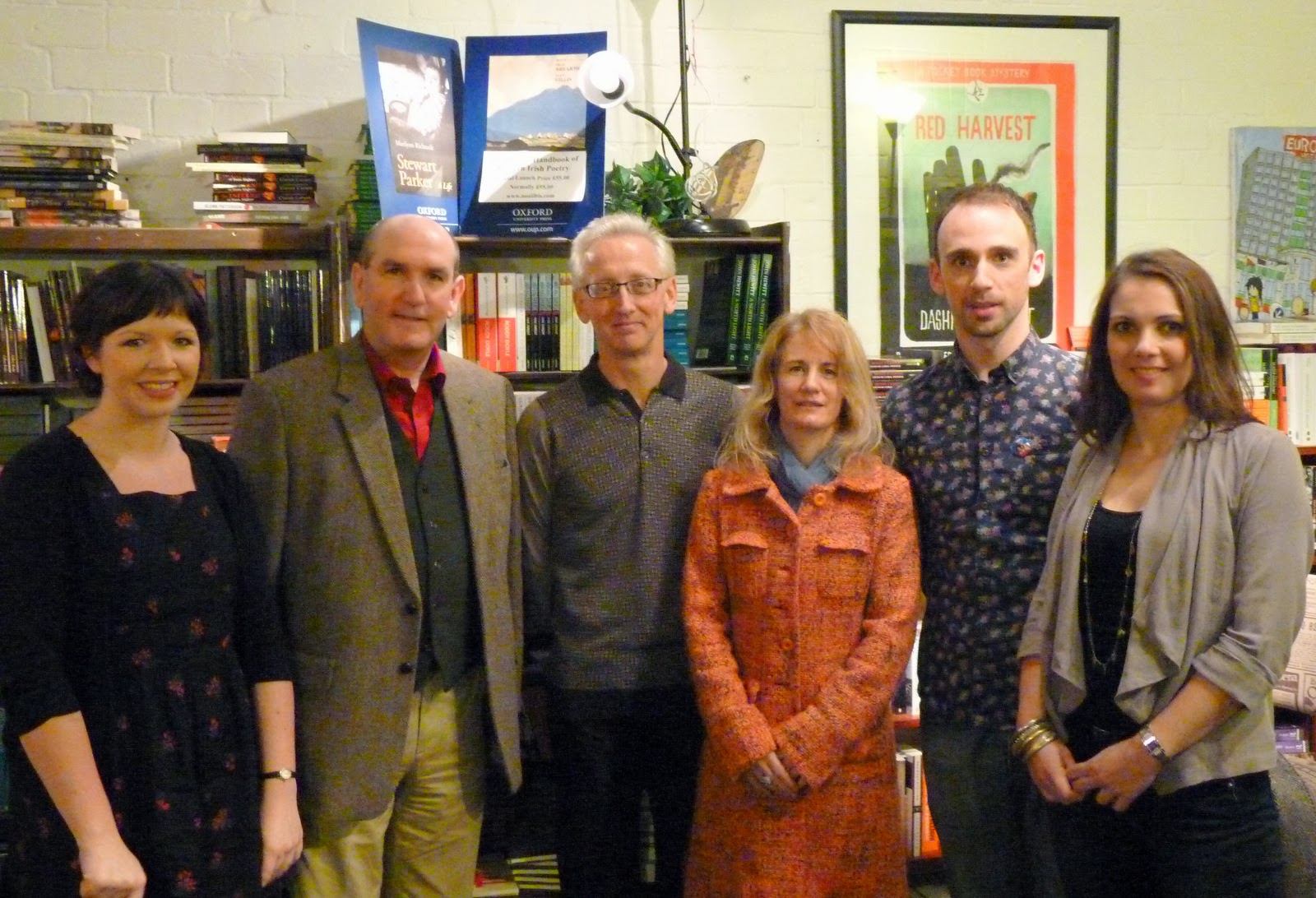
Erin, Damian, Paul, Olive, Colin and Tory

Tuesday, 5 November 2013

Samhain

Today is the ancient pagan festival of Samhain. This quarter day marks the end of Autumn and the beginning of Winter. A point at which the harvest would be completed and animals would be brought down from their Summer pasture on the hills. Samhain thus celebrates the gathering together of foodstuffs to enable survival through the darkest and coldest part of the year. It is a time of both looking back and looking forward.

Traditionally this festival was marked by special fires and feasting. A ritual bonfire would be made by a community and lit. The smoke and fire was thought to have both both purificatory and divinatory powers. Burning embers would be taken into each home to kindle the flame that would remain lit throughout Winter.

Spirits (deities and the departed) were believed to take close part in the festival and places would be laid for them at the feast table. People would also dress-up as spirits in order to invoke their powerful help for survival through the winter and for good fortune in the coming year. This signficance has led some to suggest that Samhain marked the end of one year and the beginning of the next.

Like all the main pagan festivals, Samhain was diverted by the early church into a Christian festival. All Hallows (or All Saints) Day has been celebrated on 1 November since the 9th Century and is followed by All Souls Day (2 November). These twin festivals celebrate the departed: those who have achieved sainthood and those who have yet to reach heaven.

All Hallows Eve (31 October) is now known as Halloween. Originally exported to North America by settlers from Ireland and Scotland, it has since become re-imported as a secular festival with striking pagan elements. There is the dressing up in costumes that mimic the dead, the divination of fortune (trick or treat), the use of fires and flames and the celebration of the presence of the dead amongst the living.

Tonight is also Guy Fawkes (or Bonfire) Night, a British festival with clear pagan associations which celebrates of the execution of a Catholic conspirator who sought to assassinate a Protestant monarch. Established in 1605, this sectarian festival had at its centre a community bonfire at which an effigy of the Pope was burnt. Over time the effigy became transposed into that of Guy Fawkes and later the event became secularised as Bonfire Night. Surprisingly, this festival does not appear to have taken root in NI.